Physical Address
304 North Cardinal St.
Dorchester Center, MA 02124
Physical Address
304 North Cardinal St.
Dorchester Center, MA 02124

In today’s digital-first business environment, customers expect quick, convenient, and relevant communication. Whether they are asking about a product, requesting a quotation, making a booking, checking an order, or looking for customer support, they want businesses to respond without unnecessary delays.
This is one of the reasons WhatsApp has become an important communication channel for businesses. With billions of people using WhatsApp globally, businesses can use conversations to connect with customers throughout their journey — from the first enquiry to post-purchase support. WhatsApp Business solutions are designed to help businesses communicate with customers through messaging, notifications, interactive experiences, and customer support.
However, simply having a WhatsApp number is not enough. As customer enquiries increase, businesses need a structured approach to manage conversations, follow-ups, promotional communication, bookings, and support.
Traditional communication channels such as phone calls and email still have an important role in business. However, messaging provides a more direct and convenient way for customers to interact with a company.
Customers can use WhatsApp to ask questions, receive updates, share documents, respond to offers, confirm appointments, and communicate with a business without switching between different platforms.
WhatsApp Business Platform also supports two-way conversations and interactive messaging experiences, allowing businesses to create more convenient customer journeys.
For businesses, this creates an opportunity to make communication faster while keeping the customer experience simple.
As a business grows, managing customer communication manually can become difficult.
Some common challenges include:
When multiple customers contact a business at the same time, responding to every enquiry quickly can become challenging.
Important conversations can get delayed, especially when the team is handling sales, customer support, bookings, and other business activities simultaneously.
Businesses often receive similar questions about pricing, availability, services, operating hours, booking processes, delivery, or product details.
Answering the same questions repeatedly consumes valuable time.
A customer may show interest today but need additional information before making a decision. Without an organised follow-up process, businesses can easily miss these opportunities.
Businesses may need to send reminders, confirmations, announcements, offers, or other important information to customers.
Managing these communications manually can become time-consuming as the customer base grows.
Different team members may communicate with customers in different ways. Without a structured messaging process, the customer experience may become inconsistent.
Businesses can improve their WhatsApp communication by focusing on a few simple principles.
Customers should immediately understand why they are receiving a message and what action they can take.
Instead of sending long messages filled with unnecessary information, focus on the most important details.
Whenever possible, make communication relevant to the customer’s situation.
For example, an appointment reminder, order update, enquiry response, or follow-up message should provide information that is useful to that particular customer.
A good business message should not leave the customer wondering what to do next.
Interactive buttons, links, and clear calls to action can make it easier for customers to respond, enquire, book, visit a website, or request additional information. WhatsApp Business Platform supports interactive messages and calls to action for creating simpler customer experiences.
Automation can help businesses handle repetitive tasks while allowing employees to focus on conversations that require personal attention.
For example, businesses can use automated communication for common enquiries, reminders, confirmations, notifications, and other routine interactions.
A customer enquiry should not disappear after the first conversation.
Businesses can create structured follow-up processes to ensure that interested customers receive relevant information at the right stage of their decision-making process.
Effective business communication is not about sending the maximum number of messages.
Customers should receive communication that is relevant, expected, and useful. WhatsApp has introduced controls and policies around business messaging to reduce unwanted communication, and businesses using the WhatsApp Business Platform need to follow applicable messaging policies and use approved templates for business-initiated messages.
Businesses should review how customers respond to their communication.
Understanding response rates, customer interactions, and campaign performance can help businesses improve future messaging and avoid sending communication that does not provide value.
As a business grows, managing WhatsApp communication through a basic setup may not always be enough.
A business messaging platform can bring different communication requirements into a more structured workflow. Depending on the business, this may include bulk messaging, customer engagement, interactive CTAs, links, notifications, follow-ups, and calling.
The goal is not simply to send more messages. The goal is to make every customer interaction more organised, relevant, and useful.
This is where ConnectFlow360 can become part of a business’s communication strategy.
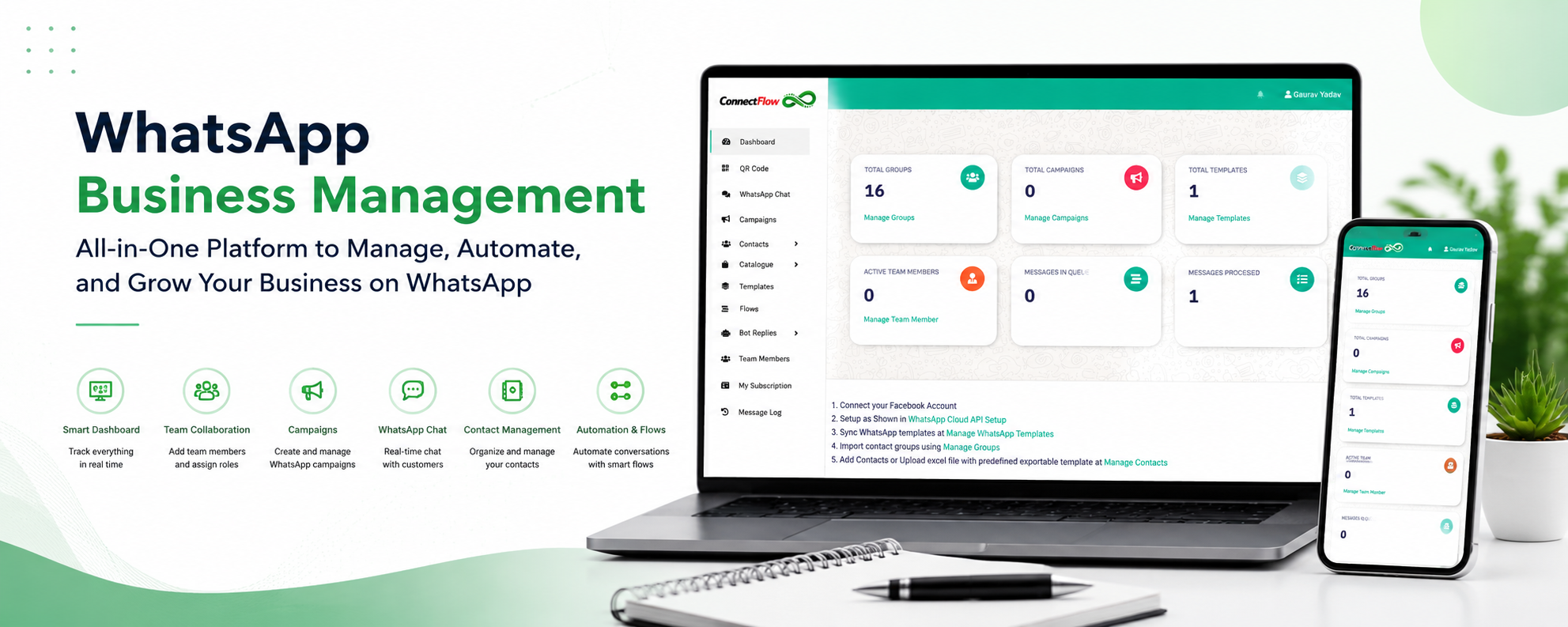
ConnectFlow360 is designed to help businesses manage WhatsApp-based communication more efficiently, bringing tools for customer messaging and engagement into a business-focused platform.
Businesses can use ConnectFlow360 for activities such as bulk WhatsApp messaging, interactive CTA buttons, clickable links, customer communication, and other engagement-focused workflows.
For businesses that communicate with a large customer base, these capabilities can help reduce repetitive manual work and create a more structured communication process.
ConnectFlow360 also provides WhatsApp calling capabilities, giving businesses another way to connect with customers when a conversation needs a more direct interaction.
The important point is that technology should support the customer experience rather than replace meaningful communication. Businesses should use messaging, automation, and calling where each is most useful.
Messaging and calling serve different purposes.
WhatsApp messaging can be useful for:
Calling can be useful when:
In India, WhatsApp has expanded business calling capabilities on the WhatsApp Business Platform, reflecting the growing importance of combining messaging with more direct customer interactions.
A strong communication strategy does not necessarily depend on choosing messaging or calling. Instead, businesses can use both based on the customer’s needs.
Before implementing a WhatsApp communication strategy, businesses should keep the following practices in mind:
Get appropriate customer consent:
Businesses should communicate with customers who have opted in where required and follow WhatsApp’s applicable business messaging policies.
Send relevant information:
Every message should have a clear purpose and provide value to the recipient.
Avoid excessive messaging:
Sending too many messages can negatively affect the customer experience.
Use clear calls to action:
Tell customers what they can do next.
Maintain consistency:
Use a professional and consistent communication style across customer interactions.
Combine automation with human support:
Automation can handle repetitive tasks, while employees can take care of conversations that require judgement, empathy, or detailed assistance.
Business communication is moving beyond one-way announcements.
Customers increasingly expect businesses to communicate with them in ways that are fast, convenient, and interactive. WhatsApp’s business tools already support conversations across marketing, sales, customer care, notifications, and commerce use cases.
At the same time, businesses need to be thoughtful about how they use these capabilities. More communication does not automatically mean better communication.
The businesses that stand out will be those that deliver the right information, through the right channel, at the right time.
WhatsApp has become much more than a messaging application for personal conversations. For businesses, it can be an important channel for customer engagement, support, follow-ups, notifications, and sales communication.
However, effective WhatsApp communication requires more than simply sending messages. Businesses need a clear strategy, relevant content, appropriate customer consent, organised follow-ups, and tools that can support communication as the business grows.
Platforms such as ConnectFlow360 can help businesses bring these communication activities into a more structured workflow, making it easier to engage with customers through messaging and calling.
Ultimately, the objective is simple: make business communication faster, more organised, and more useful for the customer.
🌐 Visit Website
💬 WhatsApp
📸 Instagram
📘 Facebook