Physical Address
304 North Cardinal St.
Dorchester Center, MA 02124
Physical Address
304 North Cardinal St.
Dorchester Center, MA 02124

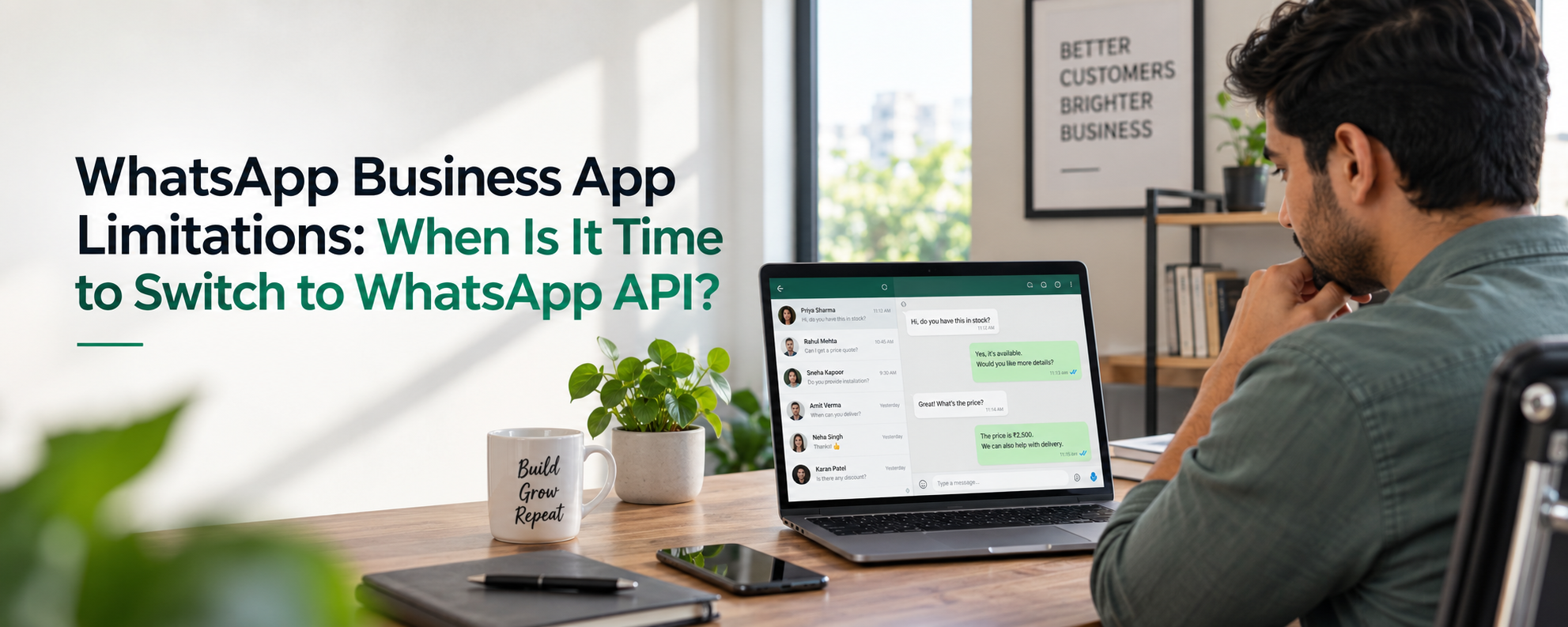
WhatsApp Business App is a useful starting point for small businesses that want to communicate with customers directly. It offers features such as business profiles, quick replies, catalogs, labels, and basic customer communication tools.
However, as a business grows, managing a larger number of customers through the app can become difficult. More enquiries, follow-ups, team members, marketing campaigns, and customer conversations often require a more scalable solution.
This is where the WhatsApp Business API can become useful.
WhatsApp Business App is designed mainly for small businesses that manage customer conversations directly from a mobile device or a limited number of connected devices.
It works well when the business receives a manageable number of enquiries and most conversations can be handled manually.
For example, a local service provider, retailer, consultant, or small shop may use the app to:
But when customer communication increases, businesses can start facing several limitations.
When a business receives hundreds or thousands of customer messages, manually handling every conversation can become time-consuming.
Important enquiries may get buried among other chats, while follow-ups can easily be missed.
For growing businesses, customer communication needs to become more organized and scalable.
The WhatsApp Business App is useful for direct conversations, but many repetitive activities still require manual effort.
Businesses may repeatedly answer questions such as:
When the same questions are asked throughout the day, manually replying to every customer consumes valuable time.
As customer enquiries increase, businesses often need automated responses, workflows, notifications, and follow-ups.
The WhatsApp Business API allows businesses to build more advanced communication workflows and connect WhatsApp with business systems and automation platforms.
This can help reduce repetitive work while allowing teams to focus on conversations that actually need human attention.
A growing business may have multiple employees handling customer conversations.
Managing communication efficiently becomes more important when sales, support, marketing, and customer service teams all need to work with WhatsApp.
Businesses may need a centralized system where customer communication can be managed more efficiently instead of depending entirely on individual phone-based conversations.
Growing businesses often need WhatsApp to work alongside their existing tools and processes.
For example, they may want to connect WhatsApp communication with:
This is one of the major reasons businesses start considering the WhatsApp Business API as their communication requirements become more advanced.
There is no single business size at which every company must switch to the API.
Instead, the decision should be based on your communication requirements.
You may want to consider the WhatsApp Business API when:
If your current WhatsApp Business App is still handling your daily communication comfortably, there may be no immediate need to upgrade.
But if WhatsApp has become an important part of your sales, support, or marketing process, an API-based solution can provide greater flexibility.
The WhatsApp Business API is designed for businesses that need a more scalable approach to customer communication.
Instead of treating WhatsApp only as a messaging application, businesses can use it as part of their broader communication and automation strategy.
Depending on the platform and setup, businesses can use API-based WhatsApp communication for:
This makes WhatsApp more useful as the number of customers and conversations grows.
WhatsApp has also become an important channel for WhatsApp Message Marketing.
Businesses can use WhatsApp to communicate with customers about new products, offers, updates, events, reminders, and other relevant information, provided their messaging follows applicable WhatsApp policies and customer consent requirements.
The key is to focus on relevant communication rather than sending unwanted messages.
A good WhatsApp marketing strategy should include:
This helps businesses build better customer relationships while reducing the risk of communication being perceived as spam.
WhatsApp Bulk Messaging can be useful when a business needs to communicate with a larger group of opted-in customers.
For example, a business may want to inform customers about:
However, bulk messaging should not simply mean sending the same message to everyone without considering relevance or consent.
Businesses should follow WhatsApp’s applicable business messaging policies and use appropriate customer opt-in practices.
For businesses running frequent campaigns, an API-based messaging platform can make campaign management more structured and scalable.
Moving from the WhatsApp Business App to an API-based setup does not always mean that a business must completely abandon its existing WhatsApp strategy.
For eligible businesses, WhatsApp Coexistence can provide a way to use the WhatsApp Business App alongside the WhatsApp Business Platform under supported setups.
However, availability and requirements can depend on Meta’s current eligibility rules and the specific onboarding setup.
Therefore, businesses should check the current requirements before deciding how to migrate their WhatsApp communication.
How ConnectFlow360 Helps Businesses Scale WhatsApp Communication
For businesses that are moving beyond basic WhatsApp communication, ConnectFlow360 provides tools designed to make WhatsApp messaging more scalable and efficient.
With ConnectFlow360, businesses can use WhatsApp for large-scale customer communication while creating a more structured messaging experience.
Key capabilities include:
This can be particularly useful for businesses that want to move beyond manually handling every customer conversation and use WhatsApp more effectively for sales, marketing, and customer communication.
Yes. The WhatsApp Business App can be sufficient for businesses with a manageable number of customer conversations and mostly manual communication requirements.
Businesses generally consider the API when they need greater scalability, automation, integrations, team-based communication, or more structured messaging workflows.
No. The API can also be useful for growing SMBs when their WhatsApp communication requirements become more advanced.
Yes, businesses can use supported WhatsApp business messaging solutions for larger-scale communication, but they must follow applicable WhatsApp policies, consent requirements, and messaging rules.
Yes. The API can support structured WhatsApp Message Marketing, including customer campaigns and relevant business communications, subject to applicable policies and requirements.
Not necessarily. If the WhatsApp Business App is meeting your current needs, you can continue using it. The right time to consider API is when manual communication starts limiting your business growth or efficiency.
Final Thoughts
The WhatsApp Business App is an excellent starting point for small businesses, but growing customer communication can expose its limitations.
If your business is dealing with increasing enquiries, repetitive conversations, larger marketing campaigns, or a growing customer base, it may be time to consider the WhatsApp Business API.
The goal is not to switch simply because your business is growing. The goal is to choose a WhatsApp communication setup that can support your sales, marketing, customer service, and automation needs as your business continues to expand.
🌐 Visit Website
💬 WhatsApp
📸 Instagram
📘 Facebook